On Dennis Ritchie

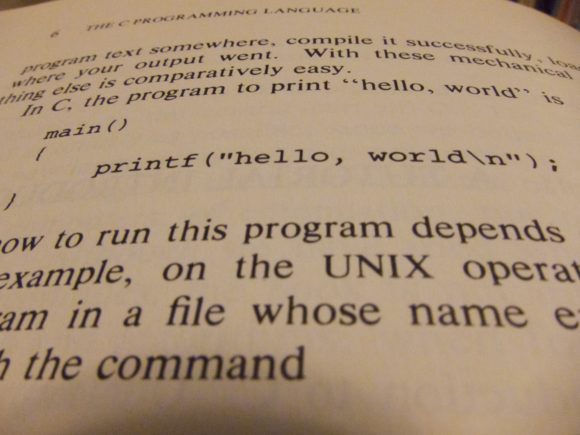
The past week there has been a ton of recognition for the contributions Steve Jobs had made to computing and society through his work. Steve Jobs was a household name. Dennis Ritchie however was not a household name. Despite this his work was amazingly influential on almost every aspect of our daily lives either directly or indirectly. Everything from the computer I wrote this blog post on to the server sending you this blog post involved his work.

Rob Pike best eulogized his work, copied below for posterity. An amazing legacy.

Continue reading

Budget Calculator Dice

When I was in High School somehow dice became popular for the 2000th time since the dawn of humanity. For some strange reason I felt the desire to build a little dice game in my TI 83 calculator in TI-BASIC. I had long forgotten about this, and recently stumbled upon it. I transcribed it to my computer recently since I don’t have one of those cables and decided to just throw it out there on the web.

Looking back on it, I could have written this a lot better ;-) . Regardless it’s a fun trip down memory lane. I believe I wrote most of this little gem while lifeguarding on a Sunday morning. Nobody drowned in the production of this code, I swear.

My favorite part may be the about text “DEPRIVING A VILLAGE SOMEWHERE OF AN IDIOT”. Someone at some point somewhere said that about me, and it stuck for years.

Continue reading

The Programmer, Like The Poet

So poetic in itself…

The programmer, like the poet, works only slightly removed from pure thought-stuff. He builds his castles in the air, from air, creating by exertion of the imagination. Few media of creation are so flexible, so easy to polish and rework, so readily capable of realizing grand conceptual structures.

- Fredrick P. Brooks, The Mythical Man-Month (Ch. 1)

Object-Oriented Masturbation

Doing some research for an upcoming installment of an infamous series of blog posts (to be released at an undetermined date) I’ve come to notice this annoyance. In general I like object-oriented programming. I think it allows you to take a complicated problem and produce simple, more reusable and easier to maintain code. Assuming the programmer is sane individual, and that sometimes is a leap of faith.

I’m not sure if there are programmers who feel the need to complicate things just for the sake of showing off (oh, look at me!), or if they legitimately don’t know any other way. I suspect a little of both. Perhaps the programmer thought it was possible the code would grow in complexity in the future, and just wanted to prepare in advance. I don’t know. But it annoys me.

I consider this abuse of Object-oriented programming to be Object-oriented masturbation since the only one who gets any enjoyment out of it is the developer who does it. Here’s a slightly exaggerated (though not far off) example of Object-oriented masturbation typical of what I’ve seen many times before:

Objective

Sum two numbers and print the result in the format “The answer is: X” where X is the sum of the two numbers.

Correct (sane) Answer

// This is the simple, obvious answer
function sum(x,y){
    document.write(‘The answer is: ‘ + (x+y));
}
 
// To run:
sum(1,1);

Arguably, you could do the math and store in a variable if you are squeamish to doing math in any line containing an output method. Regardless, this is dead obvious and simple. And yes, this technically still does use OOP since it uses document.write().

Insane (masturbatory) Answer

function MathLib(){
    this.answer = null;
}
 
MathLib.prototype.sum = function (x,y){
    this.answer = x + y;
}
 
MathLib.prototype.getAnswer = function(){
    return this.answer;
}
 
function Printer(){
    this.preText = ;
}
 
Printer.prototype.setPreText = function(str){
    this.preText = str;
}
 
Printer.prototype.out = function (str){
    document.write(this.preText + str);
}
 
// To run
var math = new MathLib();
var print = new Printer();
math.sum(1,1);
print.setPreText(‘The answer is: ‘);
print.out(math.answer);

I did the exact same thing in 1 logical line of code (3 if you include the function itself) up above. What was gained from the object-oriented design? I argue nothing. Rewriting the first example would take a minute should something need changing. If there were a need to localize that string, I could pull it out and either make that a 3rd parameter, or some global string the function can use. There’s no benefit here. This is over engineering. There’s nothing truly reusable here. The closest is the Printer.out() method, and in reality it’s a wrapper for document.write().

The bonus joke is that the object-oriented implementation is significantly slower.

Run 1: 0.0266, 0.0451
Run 2: 0.0314, 0.0464
Run 3: 0.0329, 0.0462
Run 4: 0.0268, 0.0468
Run 5: 0.0274, 0.0475
Avg: 0.02902, 0.0464

The first example is also 62.5% faster in Firefox 3.0.4 since the all that overhead is gone. If you have FireBug installed you can check that out here.

object-oriented masturbation
ob-jikt | o·ri·ent-ed | mas⋅tur⋅ba⋅tion

  1. the stimulation or manipulation of one’s own ego by way of using object-oriented code in places where it has no advantage instead resulting in unnecessary complication and bloat.

If your guilty of doing this, please cut it out. It’s annoying. Thank you.

No I will not single out links to the pages that inspired this, but rest assured it litters the web.

PHP Namespacing

The PHP folks have finally announced that PHP will get namespacing in the form of ‘\‘. The universal escape character. They really should have went with the standard ‘::‘ or ‘:::‘. Using ‘\‘ is going to work well.

I was thinking something like this would be more appropriate (background on compatibility here):

......................................__................................................
.............................,-~*`¯lllllll`*~,..........................................
.......................,-~*`lllllllllllllllllllllllllll¯`*-,....................................
..................,-~*llllllllllllllllllllllllllllllllllllllllllll*-,..................................
...............,-*llllllllllllllllllllllllllllllllllllllllllllllllllllll.\.......................... .......
.............;*`lllllllllllllllllllllllllll,-~*~-,llllllllllllllllllll\................................
..............\lllllllllllllllllllllllllll/.........\;;;;llllllllllll,-`~-,......................... ..
...............\lllllllllllllllllllll,-*...........`~-~-,...(.(¯`*,`,..........................
................\llllllllllll,-~*.....................)_-\..*`*;..)..........................
.................\,-*`¯,*`)............,-~*`~................/.....................
..................|/.../.../~,......-~*,-~*`;................/.\..................
................./.../.../.../..,-,..*~,.`*~*................*...\.................
................|.../.../.../.*`...\...........................)....)¯`~,..................
................|./.../..../.......)......,.)`*~-,............/....|..)...`~-,.............
..............././.../...,*`-,.....`-,...*`....,---......\..../...../..|.........¯```*~-,,,,
...............(..........)`*~-,....`*`.,-~*.,-*......|.../..../.../............\........
................*-,.......`*-,...`~,..``.,,,-*..........|.,*...,*...|..............\........
...................*,.........`-,...)-,..............,-*`...,-*....(`-,............\.......
......................f`-,.........`-,/...*-,___,,-~*....,-*......|...`-,..........\........


Self Serving Sausage Fest?

Does that title accurately describe open source? Via Valleywag I found this blog post from Psychology Today which I’d recommend reading. This is really the most interesting part:

First, there’s street cred: People want to garner approval from their peers and build their reputation. Second, there’s self-actualization: Working on these projects is enjoyable in and of itself, and it also provides the opportunities to practice your skills, collect feedback, and grow as a geek. Third, there’s pure altruism: Let’s save the world, one squashed bug or “[citation needed]” at a time.

Interesting stuff. I definitely fall in the “practice your skills, collect feedback, and grow as a geek” category.

Also noteworthy: 97.8 percent of open source programmers are male. Like there was any surprise that it’s somewhat of a sausage fest on #developers. Anyone ever check the ratio on about:credits? Come up with an automated way to do that’s licensed under MPL/GPL/LGPL and you’ll earn some serious street cred not to mention save the world and practice your text analysis skills.

I guess this is even more extreme than the Dave-to-Girl ratio.

Benchmarking And Testing Browsers

When people talk about open source they often talk about the products, not the process. That’s not really a bad thing (it is after all about the product), but it overlooks some really interesting things sometimes. For example open source tools used in open development.

A few months ago Jesse Ruderman introduced jsfunfuzz, which is a tool for fuzz testing the js engine in Firefox. It turned up 280 bugs (many already fixed). Because the tool itself is not horded behind a firewall it’s also helped identify several Safari and Opera bugs. It’s a pretty cool way to find some bugs.

The WebKit team has now released SunSpider a javascript benchmarking tool. Something tells me this will lead to some performance improvements in everyone’s engine. How much will be done for Firefox 3.0 is a little questionable considering beta 2 is nearing release, though you never know. There’s been some nice work on removing allocations recently. So just because it’s beta, you can’t always assume fixes will be minor in scope.

Another test that many are familiar with is Acid 2 which essentially is checking CSS support among browsers. Ironically this one too was released when Gecko is somewhat late in the development cycle.

Efforts like this really help web development by allowing browser developers to have a baseline to compare their strengths and weaknesses. Having a little healthy competition as motivation can be pretty helpful too ;-) .

Time Sucks

One of the hardest things to program is the Date and Time. This is especially true when your doing it on the web. Why is that? Using a unix timestamp is immensely helpful and resolves many of the complexities, but it does have some issues (besides the Y2K38 bug). Well lets take a look at some of the “typical” things you need to be aware of:

  • Your server is in one timezone, your users are in 23 others.
    Users don’t care what the time is at the site. They want things in their time.
  • Does your server even know your users timezone?
    You could do this with JavaScript, and send it to the server, but that’s a mess. Or send a timestamp to the client, and let JavaScript print it out. But that’s still messy.
  • Timezones aren’t obvious (think Indiana).
    Did you know some even use :30 such as UTC-3:30 for Newfoundland Standard Time.
  • Looking back in time (or forwards) is difficult (how many hours between X and Y accounting for leap years, and DST changes)?
    This is a mess, enough said. And just in case you have a formula, did you account for the conversion between Julian and Gregorian calendars? Don’t forget not everyone switched in 15 October 1582 / 4 October 1582. Going forward remember we’ll eventually have another leap day, since the Gregorian calendar isn’t perfect.
  • Your server observes DST. Does your user? When?
    Get the picture? Remember most states do, except for Hawaii (yea, that’s another Timezone) but Arizona doesn’t either, except for Navajo Nation. Again Indiana!
  • The Politics of Time…
    If you call UTC+2 Israel Standard Time, you upset visitors from Muslim nations like Egypt. Call it Central Africa Time, or Egypt Standard Time and your considered anti-semitic. Same goes for UTC+8, is it Chinese Standard Time or Hong Kong Time? Most avoid this by just listing UTC±N. Unfortunately this confuses people, especially Americans who only refer to timezones as “Eastern” (UTC-5), “Central” (UTC-6), “Mountain” (UTC-7) “Pacific” (UTC-8). Note these American names aren’t so common in all of North/South America.
  • Daylight Savings Time for 2007+
    Then you have a bunch of clowns who voted for the Energy Policy Act of 2005, creating the Y2K7 bug. The idea was an extra hour of daylight in the evening would reduce electrical use. What they didn’t realize is that it cuts daylight from the morning. My guess would be a follow up bill may fine the sun for failing to provide adequate light, and eventually include economic sanctions. :-P

I thought a while back this could suck. Think about all the time/money that goes into updating and testing systems for these few extra weeks of DST. What a drag.

Swatch Internet Time was an obvious bust, but perhaps we could all just use UTC?