Posts Tagged ‘Software’

Top Windows Programs Open Source

CNet has a slide show with it’s top Windows programs. It’s a pretty good list. I’d agree with it for pretty much everything. What I found really interesting is that of the 9 listed, 7 are open source. Here’s the rundown with the license for the source of each:

Interesting to see the penetration of open source here.

Mac Email Showdown

ComputerWorld has a rather good showdown of email clients on Mac OS X. The best breakdown of features I’ve seen on the Mac side in some time.

That said, I think they were slightly unfair to Thunderbird. For example, Thunderbird does have calendar support via Lightning which wasn’t mentioned (though it does indicate webmail support via extension). I’ve been using it with Google Calendar and it’s been working very well for me. It also says that Thunderbird can’t read from the Mac OS X Address book, though it should be noted that’s now fixed for the next release. It does however in another part of the breakdown briefly discuss Apple’s upcoming Mail release.

Another interesting note is that there doesn’t seem to be any mention of Entourage still not being available as a Universal Binary, meaning it’s very slow on Intel based Mac’s as I’ve mentioned before. We won’t see it as a Universal Binary until 2008. As someone who uses it daily at work, I’m counting down the days. IMHO this problem alone makes Thunderbird a much better mail client (minus the lack of Exchange support).

Does anyone know if Mail supports exchange? The review seems to think so (see the chart), though I thought that was only over IMAP. Apple seems to agree with me (emphasis mine):

Mail works with the following account types: POP, IMAP, .Mac, and Exchange (only if configured as an IMAP server). You can’t log in directly to Hotmail, AOL, or any service that does not support POP or IMAP access, and retrieve email using Mail.

I wouldn’t really call that support.

Other than those things which I believe aren’t quite accurate, I actually liked the review. I though it was a decent breakdown on a level I haven’t seen before. It exposes features that few really look at (search for example), but really matter in terms of user experience.

iPhone Native Applications

Someone created Mobile Terminal for the iPhone. That means one could in theory run SSH. Awesome.

[Hat Tip: Gizmodo]

Remote Desktop Connection 2.0 Beta For Mac

Microsoft yesterday released Remote Desktop Connection 2.0 Beta for Mac OS X. This is the first release since 2002. The current version was really old, clunky and limited compared to it’s Windows counterpart. Worse was the fact that it was PPC native and was never turned into a Universal Binary, making it just that much slower. This is a really welcome upgrade for all Mac users in a PC environment. Unfortunately it’s still missing key things, but it’s still beta so there is still hope.

I’m primarily a Mac user at work, but do work on a few PC’s as well, so I have RDC running constantly since I find it easier than hitting the KVM switch all the time. No, I don’t use Parallels as of yet. This works pretty well for most tasks, but on occasion when I need to do more intensive PC work I do switch over using the KVM for the time being. Because I work like this, I switched to CoRD, which is an open source Remote Desktop implementation. I’d highly recommend it. It’s very good.

RDC 2.0 has a really nice new look, and much improved performance for Intel Mac users. It does however have some issues that still aren’t addressed.
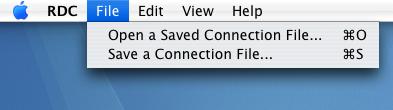
RDC Menu

Adding a computer using Remote Desktop Connection 2.0

Notice in the menu above, you can’t make a “new” connection. Only open a saved one. I can’t for the life of me understand why this is. Do I really have to plan my connections in advance? What if I’m connected to a computer and want to quickly connect to another? The only way I can find to get a prompt for a new connection is when you don’t have any connections open. This just doesn’t seem right.
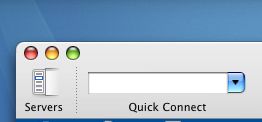
CoRD - Add Computer

Adding a computer using CoRD 0.4.1

With CoRD I can easily add a new RDC connection using the quick connect box, or by adding it to the tray. This is in my opinion essential functionality. It’s so easy to manage connections in CoRD. IMHO it’s the greatest feature this application provides.
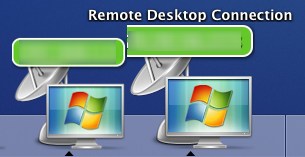
RDC - Dock

Switch between computers in Remote Desktop Connection 2.0

Having multiple connections open in RDC 2.0 gives multiple dock icons with the address of the host in the icon. A rather nice way to tell who you’re connected to. There is a bug however which results in one looking cut off on my PPC Mac Mini, not sure about the Intel one (maybe lack of Core Image support at fault?). One downside to this design is that the dock can get pretty cluttered quickly if you have a few connections open. But in my case it’s never really more than 2, so it works well for me.
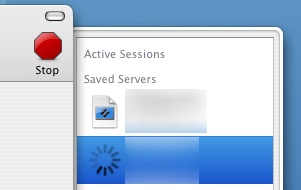
CoRD - Tray

Switching between computers in CoRD 0.4.1

CoRD uses a “tray” like interface for managing connected an saved connections. This means no connection files sitting all over your computer (yay!). It also means switching between connections is really easy, even if you had a dozen, and it doesn’t clutter your dock. It’s great interface.

New to RDC 2.0 is Full Screen mode. Something that was missing in prior versions (and really hurt). CoRD also has this feature. This is one place where both applications have shortcomings. In RDC 2.0, if your resolution isn’t ideal for your display, it crops and looks really poor. In CoRD if you are using a windowed view, and go full screen, it disconnects then reconnects to go full screen. This is a real drag. There is however a workaround for CoRD. The trick is to start full screen and exit if you want to use it windowed. CoRD then seems to scale down the resolution but maintain the same connection. Despite scaling the fonts are still very readable.

I don’t think CoRD can map drives though. That’s a pretty nice feature.

Overall I think I’ll be using both applications depending on the tasks at hand, but I think I still prefer CoRD.

For anyone wondering, Entourage on an Intel Mac isn’t bad. Can’t wait for the next release where everything is a Universal Binary. PowerPoint is dead to me until that upgrade.


OpenOffice Carbonized for Mac OS X

Not too long after Sun put some resources into giving OpenOffice some Mac love, OpenOffice for Mac is finally becoming a reality. It’s great to see this happen. There are a fair amount of serious issues, and I wouldn’t recommend running it yet, but keep an eye out. This can really change the office productivity landscape.

Coda Coolness

So I downloaded and tested out Coda a little bit today. My initial impression is that I’m very impressed. It could be the new standard. A few like Alex King point out that it uses Safari as the default engine. I don’t think that’s so bad. Nothing stops you from using 2 windows one being Firefox (obviously running Firebug). I think the editor itself is rather well polished and very refined. The use of Bonjour to allow for collaboration makes it perfect for multi-developer environments. And yes, you can have more than two developers collaborating in 1 document.

My typical workflow is very abrupt. I tend to have Firefox, IE, and an IDE open at all times when coding pages. Not to mention a KVM switch to go between platforms. This still consolidates several things, and with a much nicer UI.

I’ll need to try it (for actual development purposes) for a few days before I could tell if it really works as well I hope. Panic is one of my favorite Mac developers. Really well polished products are their specialty.

Is Vista For Me?

CNet’s review pretty much sums up my feelings on Vista after playing around with it for a little while:

The bottom line: Windows Vista is essentially warmed-over Windows XP. If you’re currently happy with Windows XP SP2, we see no compelling reason to upgrade. On the other hand, if you need a new computer right now, Windows Vista is stable enough for everyday use.

I don’t see a reason to upgrade. There’s nothing I really want/need in Vista that I’ve seen. Aero is a giant waste of battery life on laptops, not to mention it’s GPU hungry. So I don’t see my laptop enjoying that. Then there is the issue of all the DRM, and “security” (aka annoyances) they built in. Not to mention the added cost of upgrading older software to work with Vista. XP seems to do the job just as well as Vista does. Oh yea, it’s not exactly priced to sell.

Perhaps by Vista SP1 there will be some compelling feature or benefit. At least for now I don’t see what the big deal is.

On the other hand, I’m somewhat impressed by the Office 2007 release. In my opinion it’s much more polished than past releases. I’m still using Microsoft Office XP (2002) since there was nothing in subsequent versions worth upgrading for. This one may be worth getting, though I’ll likely wait until they shake the remaining bugs out and it’s a bit more used in the real world. I have a feeling corporate adoption may be a little slower due to the UI changes. This upgrade may require some retraining of employees, and I’m sure many companies won’t be into that.

Autographed Copy Of Windows Vista

I have iWoz autographed by Steve Wozniak. Do I need to get a signed copy of Vista Ultimate?

If I were to get that, Steve Jobs would need to sign a copy of Leopard or I would have trouble sleeping at night.

[Hat tip: Engadget]
Disclaimer: Affiliate linkage used in Amazon links

Installer Mess

Benjamin Smedberg has an interesting post on Ubuntu and it’s effort to be a provider of not only the OS, but the software around it. I think the ’solution’ Ubuntu choose is really a workaround for a fundamental flaw in Linux. Getting software to run quickly and easily without intimate knowledge of the OS is tough at best.

By far the best out there, though not without it’s faults is Apple. Not only are many installs just drag/drop (though that is rather cool), but ones that do require an installer typically use Apple’s installer functionality, providing a very simple interface for the user. Most importantly when Apple switched to x86, they realized users don’t know/care what’s inside their computer, or about the differences in x86 and PPC architecture. The solution they came up with was “Universal Binaries” (similar to how FAT versions of applications were used when moving from 68k to PPC). At the end of the day, the user knows nothing. The software does the work. As good as Apple’s effort is, there is a flaw, uninstalling is not always the best. In most cases it’s just drag it to the trash, but there’s no undo for installed stuff like drivers.

Ubuntu would be best off pushing for the Linux community to follow a model similar to Apple with a few changes:

  • Encourage applications to ship in the same package, and encourage distributions to use the same package installation system. Just like Apple, the user will have a familiar and obvious way of adding applications to their computer.
  • This is the tough part: 1 download for most popular Linux distributions. So it doesn’t matter what version of ____ your running, you can just install and let the installer figure it out similar to Universal Binaries.
  • One up Apple by providing a “roll back” or uninstaller that will remove and restore to what the system was before the installation was done.

Installing software on Linux stinks. Ubuntu is much better than the rest, but I don’t like how you have to rely on Ubuntu in order for that to be the case. There’s a market for someone who can solve the problem. It’s a barrier between Linux and the general user. Until someone solves it, Linux will likely remain a niche product in the desktop market.

raccettura’s Picks

I use a few extensions on a routine basis, so I thought I’d spend a moment just listing what I use, briefly explain them for anyone curious. I do quite a bit of web related work (hence the developer slant) as well as some Firefox/Thunderbird and extension hacking. For now I’ll just stick with Firefox extensions, and save Thunderbird Extensions for another post.

These are taken from my Addon Manager (formerly Extension Manager) window and ordered in a way I thought made most sense. No bribes were taken (though welcome ;-)). This is literally the stuff I personally use and recommend.

Web Development

Web Developer

If you don’t know this one yet and do web development, you should be ashamed of yourself. I’ve yet to see a developer not go crazy over this. The Web Developer extension doesn’t do anything, it does everything. By that I mean it has a whole bunch of small tools to make a web developers life easier. From fine control over cookies, to outlining block level elements, to submitting a page (even local) to the W3C validator to disabling JavaScript. No function on it’s own is truly groundbreaking but the extension as a whole is. If you do web development you need it. I couldn’t imagine developing without it. [Get it]

Firebug

Imagine viewing behind the scenes of a webpage. No, not the source code, but how javascript really executes. Debug, view XMLHttpRequests, add breakpoints, and view more DOM info. Again an absolute must have. This extension also has saved me hours of debugging time. One thing noteworthy is the design of the tool is really fantastic, it’s well organized and implemented to make it rather easy to use, despite the overwhelming amount of info it can provide. [Get it]

LiveHTTPHeaders

Viewing HTTP Headers is insanely useful when debugging web applications. Of course you can use telnet on port 80 and be a geek, but that’s way to much effort. WebDeveloper has similar functionality, but I like how this is integrated into the Page Info window, rather than opening into a new tab. I just find it easier to read, hence more usable. It’s been a staple for me for a few years now. [Get it]

DOM Inspector

As it says on the homepage: “DOM Inspector is a tool that can be used to inspect and edit the live DOM of any web document or XUL application.” This little gem is must have for any JavaScript, Firefox, or Firefox Extension development. It’s saved my butt a few times. It’s interface isn’t the best, but it does have it’s perks. [Get it]

IE Tab

This extension lets you view pages in IE’s rendering engine, but in a Firefox tab. I use this for checking how a page loads in IE (much quicker to right click then to open IE and copy/paste the URL). Again simplicity rules! [Get it]

Small Screen Renderer

Glazou thou art my hero for this one. Simply put it takes your webpage and smushes it up so you can see what it would look like on a small screen device like a handheld. With things like MiniMo, this is very worthwhile. He’s done to many cool things (Composer, CaScadeS) to mention here. [Get it]

ColorZilla

Being that I’m not graphically inclined I don’t need this much, but every so often it’s very useful. This extension lets you see exactly what the color is, pretty much anywhere on the site your viewing. Yea, that is awesome. A big timesaver, and pretty clever design.[Get it]

Everyday Browsing

downTHEMall

Every so often you run across something where you want to download everything in site. Either a series of zip files, images, or something else. You can click on each one… or you can use this awesome extension which will find them and download them all for you. [Get it]

ReloadEvery

This is just a cool way to reload a page on an interval. Great for monitoring a page. When not working on my computer I sometimes use this to just keep refreshing a page so I can glance at my display and see what’s going on. Simple and helpful. [Reload Every]

Resizeable Textarea

Asa pointed this one out. Resizing textareas is a must. If it were up to me, this would be included in Firefox 3.0. It’s awesome and infinitely useful. I personally think it qualifies as a killer feature. [Get it]

Screen Grab

I don’t use this one every day, but sometimes you don’t want to print a webpage, but want to save it. This is especially true because printing, or making a PDF sometimes distorts the page from it’s original appearance. Well the solution is to save a screenshot (another thing IMHO should be an option in Firefox as an alternative “type” in the “Save Page As” option. [Get it

GeoLocateFox

Yes, I eat my own dogfood. Seeing where websites are located is fun. Nuff said. [Get it]

User Agent Switcher

Sometimes sites kick you out because you don’t use IE. That’s not cool (go to the help menu and select “Report Broken Website” if you encounter that). A workaround is to fake being IE. This extension allows you to do just that. Though if you do that, remember to change it back to Firefox. Partially for compatibility reasons on sites that serve specific code, and so that webmasters realize how many Firefox users actually visit their site. [Get it]

Mozilla Development

TinderStatus

Tinderstatus is simple but cool. Just lets me know if the tree is one fire. [Tinderstatus]

Obviously DOM Inspector is some help here as well.

I was debating if I should throw some screenshots in here, but I decided against it since most screenshots of extensions stink (at best) since they don’t capture the value of it.

So there you have it, the extensions I use the most. Check them out.